Cosmetic Surgery > Face > Ears Otoplasty
Otoplasty - Protruding Ear Correction
Ears positioned on either side of the head are barely visible from the front. It is their visibility in this position that defines excessively protruding ears.
10% of the population has ears that do not conform to the standard shape or position. A significant non-standard angle between the ear pavilion and the skull is called conchal valgus, and it is this morphological anomaly that creates the "protruding ear" appearance, most often due to a lack of antihelical fold.
In the majority of cases, this is a congenital malformation.
Otoplasty, performed by a Specialist Cosmetic Surgeon, is a safe procedure delivering natural results. Dr Weiss, specialist in facial cosmetic surgery in Paris (Hauts-de-Seine), invites you to discover the answers to the main questions about otoplasty.
Who is otoplasty for?
Protruding ears can cause a very significant complex, already in the daily life of young children who are traumatised and excluded, the subject of mockery and sometimes bullying from their peers.
Otoplasty can be performed from the age of 7-8 years, when ear cartilage maturation is complete and children become receptive. To operate on a child, the child must formulate the request themselves; Dr Weiss will never operate on a child solely at the parents' request.
This procedure can significantly improve patients' quality of life.
What is the solution for correcting protruding ears?
The treatment of protruding ears is called otoplasty, a surgical procedure that reshapes excessively visible ear portions with cartilage folding to reduce the cephalo-chondral angle and pin the ears closer to the skull. The ears will become standardised and will no longer attract attention.
Surgical principles of otoplasty
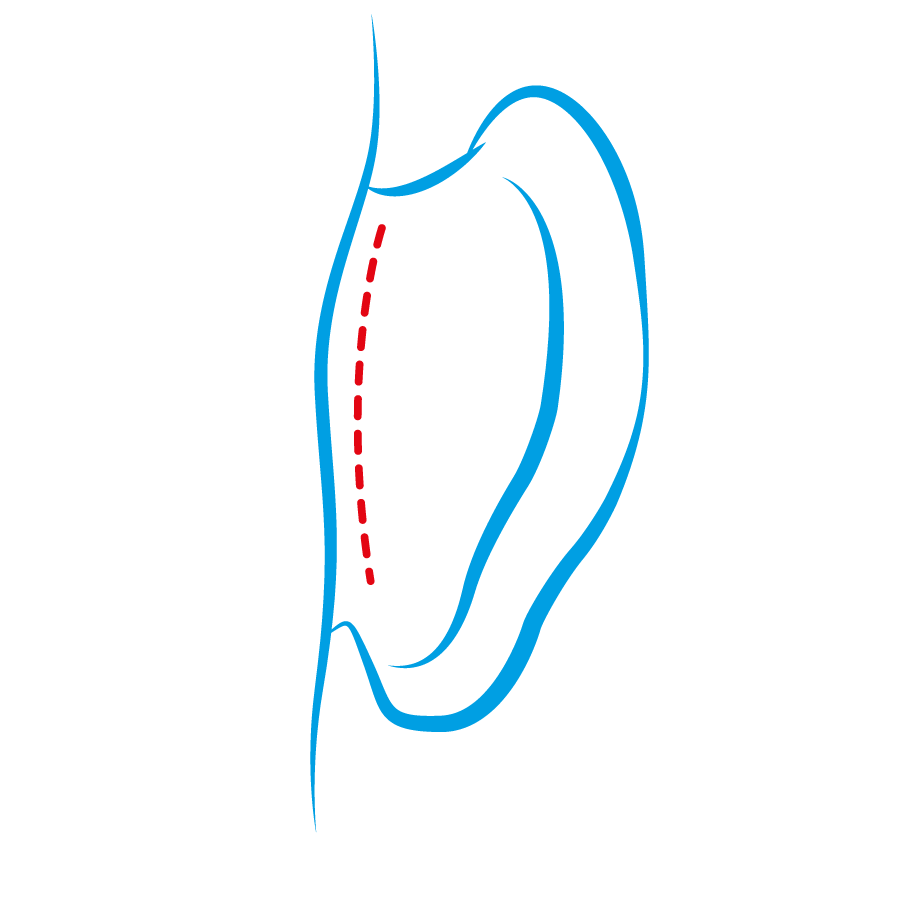
Dr Weiss uses the modified Chen Chet technique which ensures a natural and harmonious result. The procedure involves permanent cartilage remodelling followed by excision of excess skin behind the ear.
The procedure corrects asymmetric ears, curvature defects of certain cartilage portions, and helix valgus (ear protrusion).
It is generally performed bilaterally, but unilateral correction may sometimes be sufficient.
It is very important to apply a specific dressing called a hemi-helmet which stabilises the result, worn for 4-5 days then replaced with a light bandana.
Important
Dr Weiss personally operates on both sides using proven surgical techniques. Hearing is not affected by otoplasty.
The effects of otoplasty
The effects of otoplasty are spectacular and stable. This is a permanent change.
Alternatives to otoplasty
- "Ear fold" placement, increasingly abandoned due to several post-operative complications.
- Abstention
Otoplasty: the process
The procedure begins from the very first consultation with establishing mutual trust and a deep understanding of the surgical process.
Dr Weiss will answer all your questions with precision.
Practical information about otoplasty
- Dr Weiss operates personally with maximum safety
- Local anaesthesia with sedation or general anaesthesia
- Duration: 1 to 1.5 hours
For children and adolescents, the procedure may be partially covered by French social security.
- Dr Weiss personally ensures post-operative follow-up
- Outpatient (same-day discharge)
- Bandana to be worn for 3 weeks
- Suture removal after two weeks by Dr Weiss
- Results visible immediately, final stabilisation after 3 months
The 4 key benefits of otoplasty

Patient reviews
Je souhaite partager mon expérience avec le Docteur Weiss suite à ma réduction mammaire réalisée il y a deux semaines.
Le Dr Weiss est un chirurgien exceptionnel. Professionnel, à l'écoute et bienveillant. Son expertise et sa précision sont remarquables.
J'ai réalisé une rhinoplastie avec le docteur Waldemar Weiss en septembre 2025 et je suis absolument ravie du résultat, c'est harmonieux, naturel et exactement comme je le souhaitais.