Cosmetic Surgery Lipofilling
Lipofilling or Lipostructure (Fat Modelling)
in Paris, Cosmetic Surgery Centre near Paris and Courbevoie
This is a technique of transferring your own fat, called autologous fat, from one part of the body to another. It is an autograft of your fat cells called adipocytes.
From 1995, thanks to the technique developed by Sydney Coleman, the method became very reliable.
The enormous advantage of the technique is that no foreign body is introduced into your body, and the cells that survive the graft will remain and evolve with you throughout your life.
Lipofilling, performed by a specialist cosmetic surgeon, is a safe surgery producing natural results. The specialist surgeon will work meticulously on your facial volumes. Dr Weiss, specialist in facial cosmetic surgery in Paris (Hauts-de-Seine), invites you to discover the answers to the main questions about lipofilling.
Why Consider Lipofilling?
The liposculpture technique is used with particular effectiveness to restore volume, by filling and giving the desired shape and volume to different body parts. This autologous fat cell graft can fill hollows and recreate volumes that are objectively or subjectively missing.
Solutions to Restore Volume with Your Own Tissue:
The best indications for lipofilling are injections or micro-injections in the context of facial rejuvenation; in this case, facial lipofilling is most often combined with a facelift; this technique, frequently practised by Dr Weiss as a combined facelift, produces excellent results.
It significantly improves the result of a classic cervico-facial facelift by restoring volume beneath wrinkled faces: this is a combined facelift.
With lipofilling, one can permanently augment cheekbone volume, temple volume, nasolabial folds, lips, reduce tear trough depth and nasolabial fold depth.
Autologous fat can also be used to augment chin projection.
Facial lipofilling is not recommended for very thin patients.
In profiloplasty, liposculpture allows chin advancement and lip volume change by replumping them.
Principles of Lipofilling
The lipofilling technique systematically involves four stages:
- Fat harvesting, as atraumatically as possible, with blunt cannulas.
- Fat purification, which reduces the possibility of enzymatic resorption through centrifugation or filtration.
- Injection of your own autologous fat using fine blunt cannulas to obtain a substantial mesh.
- Closure of harvesting and injection sites, dressings.
Since lipofilling involves grafting your own fat cells, perfect symmetry cannot be guaranteed, as normal resorption occurs randomly.
For these reasons, Dr Weiss is always by your side to monitor the process and stabilisation of results, and correct them if needed. Resorption of fat that does not survive the graft can last for 3 months; after this period, the result is definitive.
If resorption is too pronounced, multiple re-injection sessions of your own fat are entirely feasible. The number of injections is not limited in principle.
Important: Dr Weiss personally operates both sides using proven surgical techniques.
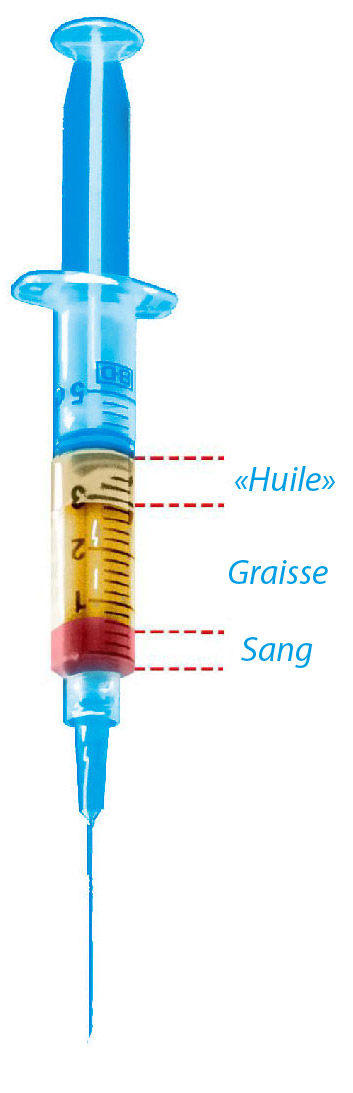
Effects of Lipofilling
The auto-grafted fat survives if in contact with vascularised tissue, hence the injection must remain filiform to obtain a fine mesh that can survive in contact with living tissue.
This technique requires transient over-correction, as not all fat cells survive after grafting; survival is estimated at between 25 and 30% in the best cases: this is the major drawback of the technique.
Large volume fat injections do not deliver the intended results and can be a source of complications, ultimately leading to fat necrosis called steatonecrosis.
Defects Not Treated by Lipofilling Alone:
- Superficial wrinkles (sometimes treatable with peels)
- Forehead wrinkles (effectively treated with Botox)
- Folds remain visible despite notable improvement (if no facelift is associated)
Possible Associated Procedures
Alternatives to Lipofilling
For a "healthy glow" through aesthetic medicine procedures:
- Restoration of lip and cheek volume, and reduction of folds through Hyaluronic Acid injection
- Abstention
Lipofilling: The Process
The procedure actually begins from the very first moments of the initial consultation. It starts with establishing mutual trust and a deep understanding of the surgical approach.
Cosmetic surgery is not only the art of operating, but also the art of listening and analysing wishes, to meet patient expectations and achieve an optimal, harmonious and natural result. In two words: "bespoke."
It is necessary for the surgeon to understand the request and enable a balance between the body, the face and its perception. It is essential to guide or sometimes even refuse the operation when the request seems unreasonable or the procedure risks not delivering the expected result.
Dr Weiss will answer all your questions precisely (stay, procedure, anaesthesia, risks, post-operative care, quote...).
Dr Weiss will perform a thorough anatomical examination. He will take into account your medical history and current condition. He will verify the feasibility of your request and, thanks to his artistic expertise, guide you in your thinking about achievable results.
Practical Information About Lipofilling
- Operation under general anaesthesia
- Duration: 30-40 minutes (if not combined with other procedures)
- Day-case hospitalisation (same-day discharge)
- Rest: 2 days
- Physical discomfort for two weeks
- Social downtime: 1 to 2 weeks
- Sports resumption from the 3rd week progressively
- Sun protection for scars for 1 year
- Result visible immediately, definitive stabilisation after 3 months
The 11 Key Benefits of Lipofilling

Patient reviews
J'ai été opérée par le Docteur Weiss et je ne peux que le recommander les yeux fermés. C'est un médecin extrêmement professionnel, très compétent, à l'écoute.
Je recommande le Dr Weiss les yeux fermés : un médecin à l'écoute et de très bons conseils. J'ai fait appel à lui pour une liposuccion qui s'est très bien passé.
Le Dr Weiss est un chirurgien exceptionnel. Professionnel, à l'écoute et bienveillant. Son expertise et sa précision sont remarquables.