Botulinum Toxin Injections
This information sheet has been designed under the auspices of the French Society of Plastic, Reconstructive and Aesthetic Surgery (SOF.CPRE) as a complement to your initial consultation, to address all the questions you may have if you are considering this procedure.
The purpose of this document is to provide you with all the necessary and essential information to allow you to make your decision with full knowledge of the facts. We therefore advise you to read it with the utmost care.
Definition
Botulinum toxin is a substance that reduces muscle contraction by acting at the neuromuscular junction (muscle-relaxing action).
Since 1975, physicians have used botulinum toxin to correct strabismus in children, facial tics and uncontrollable eye blinking.
In France, the first marketing authorisations appeared from 1990 for certain pathological indications (ophthalmology, ENT, functional rehabilitation, neurology).
Regarding aesthetic medicine, Dr CARRUTHERS, an ophthalmologist in Canada, was the first to notice that his patients treated with botulinum toxin had fewer wrinkles around the eye than others. In 1990, an observant patient asked him to harmonise the other eye: this is how the aesthetic indication was born.
Botulinum toxin under the name BOTOX received US Food and Drug Administration (FDA) approval in 2002 for use in the treatment of inter-brow wrinkles or "frown lines."
Since 2003, the French administrative authorities responsible for drug control have granted marketing authorisation for aesthetic use of botulinum toxin under the names VISTABEL, AZZALURE and BOCOUTURE.
This authorisation concerns aesthetic use for the treatment of glabellar wrinkles (inter-brow wrinkles or "frown lines") under certain conditions of practitioner competence and use.
Should injections be performed in the aesthetic field outside this anatomical site, they would then be administered "off-label."
In practice, the most common indications for botulinum toxin in aesthetics concern frown lines, forehead wrinkles and crow's feet wrinkles.
Principles
The principle of botulinum toxin consists of utilising the muscle-relaxing properties of this product.
The most commonly sought goal is to reduce the action of muscles located at the forehead and brow level, in order to attenuate both horizontal and vertical wrinkles caused by the contraction of these muscles.
Objectives
From a broader perspective, it should be understood that eyebrow position is maintained by a balance between two opposing forces, consisting of depressor muscles (located near the eyebrows) and an elevator muscle (the frontalis muscle).
Horizontal wrinkles are due to contraction of the frontalis muscle, which is an elevator. Vertical inter-brow wrinkles are caused by contraction of the depressor muscles.
The essential objective of this treatment is to reduce wrinkles and fine lines at rest and not to prevent muscle contraction: the result is therefore judged primarily on the appearance of wrinkles at rest.
Regarding the balance between depressor and elevator muscles, botulinum toxin, by attenuating the action of one muscle group, reduces the wrinkles caused by those muscles but releases the action of the antagonist muscles: the aim is to treat the muscular balance and thus achieve facial harmonisation.
Botulinum toxin treatment must be planned and managed over time: it is therefore advisable to treat gradually and to avoid the risk of "overdoing it" during the first injections.
It is better to have a first session that is moderately effective than too effective: it is therefore not advisable to seek an optimal result from the very first injection.
In some cases, several injection sessions may be necessary before optimally adapting the product's capabilities to each patient.
Before the injections
No particular preparation is necessary.
On the day of the injection, you do not need to fast. For women, it is advisable to arrive without make-up or to remove it before the injections.
It is very important to minimise the risk of bleeding in the treated areas by avoiding aspirin during the 15 days before and 15 days after the injections.
The following contraindications must be respected:
• Certain neuromuscular diseases such as myasthenia gravis.
• Pregnancy and breastfeeding: being pregnant, even by only a few days, absolutely requires postponing the injections until after pregnancy and the cessation of any breastfeeding. In case of doubt, appropriate tests should be performed and the results communicated to your physician.
• Botulinum toxin is contraindicated in cases of known hypersensitivity to botulinum neurotoxin A or serum albumin, and in patients being treated with aminoglycosides (a family of antibiotics).
A number of precautions should also be observed:
• If you are being treated elsewhere with botulinum toxin injections for pathological spasms, if you have had an episode of facial muscle paralysis, if you suffer from a neuromuscular disease or coagulation disorders, you must inform the practitioner managing your Botulinum Toxin injections. They will then assess, together with your treating physician, the advisability of injections and how to proceed if appropriate.
• If between now and the injections you take anticoagulant medications, aspirin or antibiotics, or if you have any health problem (particularly infection, flu, dental abscess, etc.), you must inform your physician before the injection.
• As a general rule, do not hesitate to mention any health issue to your practitioner so that they can assess the advisability of injections. Similarly, you should inform them of all your questions and mention all treatments you have undergone or are currently undergoing.
Type of anaesthesia
No anaesthesia is necessary.
Injection procedure
The treatment will be performed at the practitioner's office or in a clinic, according to your physician's choice and habits.
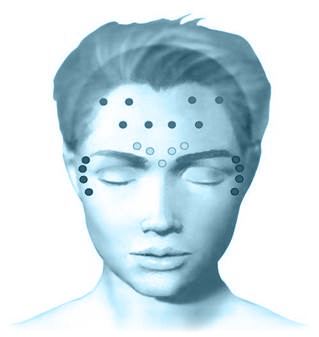
This treatment consists of a series of injections at the facial level. The needle is fine, and the injections are usually only mildly painful.
The duration of the treatment is on the order of a few minutes.
After the injections: recovery
During the two hours following the injections, it is recommended not to engage in intense sport and not to lie down.
Facial manipulations or firm massages should also be avoided during the 24 hours following the session.
It is very important to minimise the risk of bruising or bleeding in the treated areas during the fifteen days before and fifteen days after the injections (to limit the risk of product diffusion towards peripheral muscles, which could cause unwanted effects).
Furthermore, during the three days following the injections, it is advisable to strongly contract the injected muscles three times per day for approximately 5 seconds per muscle.
Usually, recovery after these injections is straightforward. Some slightly swollen marks persist for 20 to 30 minutes then disappear.
Patients can resume their normal activities after the injections.
A few rare adverse effects may appear.
They are transient.
These may include:
• Redness: localised redness at the injection sites has occasionally been reported and rarely persists beyond 3 to 6 days.
• Ecchymoses ("bruising"): bruises are in fact rarely observed at the injection sites and may persist for a few days.
• Oedema: swelling, most often around the eyes, may develop progressively over 4 to 5 days, then decrease over a few days to a few weeks.
• Sensory disturbances: a sensation of tension or fixity of the forehead, mouth or neck, depending on the areas injected, as well as altered sensitivity often linked to a cardboard-like sensation, may persist for several days.
• Fleeting ocular or facial pain: such pain has been described in the injected areas in an entirely exceptional manner.
In any case, following these injections, do not hesitate to contact your practitioner if you have the slightest concern.
The result
The result consists of wrinkle attenuation with preservation of small movements: it is obtained three to fifteen days after the injections.
Effects: the results are visible after a few days but for approximately 15 days, the effects on the face may be variable (even asymmetric at times) before eventually stabilising.
The result obtained after the first session lasts on average 3 to 6 months, after which the injection can be repeated.
The goal of these injections is to bring about an improvement, not to achieve perfection. If your expectations are realistic, the result obtained should give you great satisfaction.
Injection frequency: injections must be performed several times at intervals of 3 to 6 months to achieve a certain stability of result. From the second injection onward, results may be more lasting (6 to 8 months). Injections should then be repeated every 3 to 6 months.
However, it is recommended never to schedule injection sessions less than 3 months apart, notably to avoid creating resistance to the product through a "vaccine effect." The appearance of the result may be stabilised beyond 3 injections, but in some cases, 8 to 10 injections may be required to achieve a certain stabilisation of the result.
Conversely, it should be noted that if injections are discontinued, the treated muscle returns to its pre-injection function.
Imperfections of result
Localised imperfections
In some cases, localised imperfections (persistence of small fine lines) may be observed without constituting real complications. They depend on the surface appearance of the skin, which may already present, before injections, a permanent "crease" due to the long-standing nature of the wrinkle.
Insufficient or even asymmetric results may also occur: these are due to the fact that we have muscles of varying strength and often asymmetric.
These imperfections are generally treated by a complementary Botulinum Toxin injection the month following the injection.
It should be noted that while a localised complementary injection may sometimes be desirable after an injection to perfect the result, it should not be performed before the 15th day because muscular balances (equilibrium between muscle groups) take approximately 15 days to establish.
Residual asymmetry
Asymmetry between the two sides of the face, as well as wrinkles more marked on one side than the other, most often exist before the injection.
Furthermore, the muscle responsible for the wrinkle may be more powerful on one side than the other. This is generally analysed before the injection. In such a case, injections will follow an adapted technique, slightly different from one side to the other. Despite this precaution, residual asymmetry may persist and may potentially benefit from a complementary injection.
Aesthetic procedures aim to make you happier and satisfy you within realistic proportions. However, it sometimes happens that the expected effect is not achieved and that these procedures instead increase pre-existing psychological concerns. The post-injection experience can be extremely different from one patient to another, even with a comparable aesthetic result.
In the case of Botulinum Toxin, rejuvenation is obtained in exchange for a reduction or even disappearance of certain facial expressions. This aspect has been evaluated with you to avoid the risk of disappointment, particularly if you are an actor, presenter, etc.
Possible complications
Complications are very rare.
The known potential complications to date are as follows:
Loco-regional complications:
• Headaches: they may be present after the first injections and disappear within a few hours to a few days.
• Brow ptosis: forehead injection may cause a slight lowering of the eyebrows. This lowering is generally due to the fact that the eyebrows were already in a low position before the injection. This slight eyebrow lowering usually resolves within a few weeks.
• Eyelid ptosis: injection of frown lines may cause partial drooping of the upper eyelid that may last 4 to 8 weeks. It is rare (less than 1% of cases) and always resolves beyond a few weeks.
• Difficulty smiling and swallowing: lip injection may cause difficulty smiling or small abnormal movements. Injection in the neck area may cause difficulty swallowing.
• Dry eyes: due to decreased tear secretion, potentially causing keratitis, particularly in contact lens wearers (in this case, care should be taken to properly hydrate the cornea).
• Paradoxical muscle contraction and mimicry disturbances: in the days following injection, treated muscles may present some harmless paradoxical movements (spontaneous contractions).
General complications:
They are entirely exceptional.
• Allergic reaction: skin rash, urticaria, general allergic reaction.
• Nausea, dizziness
• Fatigue, fever, flu-like syndrome
• Dry skin or mouth.
These are the information elements we wished to provide as a complement to the consultation. We advise you to keep this document, re-read it after the consultation and reflect on it at your leisure.
This reflection may raise new questions for which you will need additional information. We are at your disposal to discuss them again at a future consultation, by telephone, or even on the day of the procedure itself, when we will in any case see each other before the anaesthesia.

Patient reviews
Le meilleur chirurgien que j'ai rencontré ! Je le recommande à absolument tout le monde. D'une gentillesse rare, drôle, rassurant, ultra à l'écoute et incroyablement compétent.
J'ai été opérée par le Docteur Weiss et je ne peux que le recommander les yeux fermés. C'est un médecin extrêmement professionnel, très compétent, à l'écoute.
Ma femme a réalisé une liposuccion avec le Dr Weiss et tout s'est parfaitement déroulé. Chirurgien très professionnel, à l'écoute, rassurant et extrêmement sérieux. Le suivi est impeccable.